


26 September, 2025
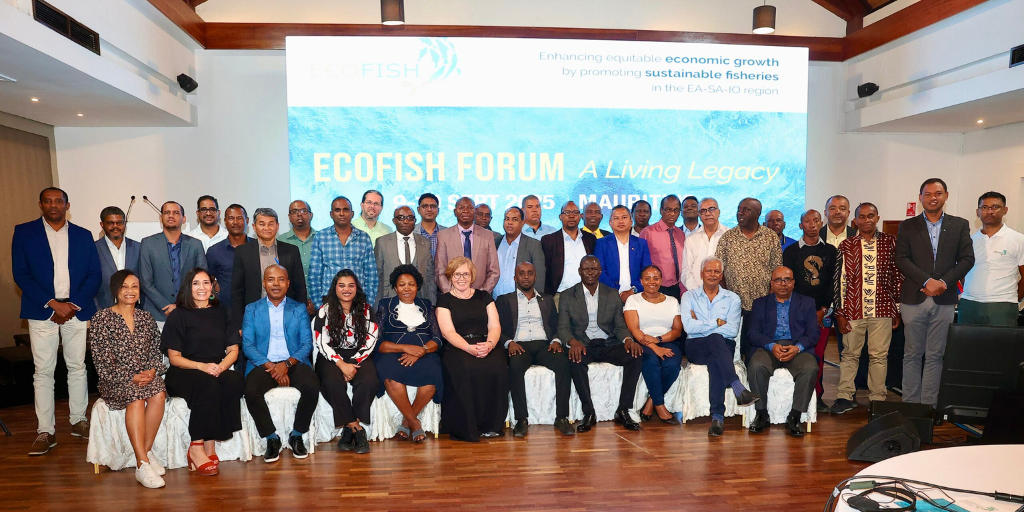
The ECOFISH program, funded by the European Union and implemented by the Indian Ocean Commission (IOC), has concluded with a strong legacy for the future of the fisheries sector in the East and Southern Africa-Indian Ocean (EA-SA-IO) region. For six years, the program, technically led by Incatema, has focused on responsible management of both artisanal and industrial fisheries through strong regional cooperation.
Innovative tools and replicable governance
One of ECOFISH's main achievements is the creation of the Coordination Platform for Sustainable Fisheries and the Blue Economy in East Africa and Sur (ESA-SFBE-CP). This platform, designed as a regional and sustainable mechanism, offers key tools in three pillars.
1. Data for better management: includes, on the one hand, the Blue Economy Fisheries Statistical Account (BEFSA) to measure the sector's contribution to GDP, trade and employment.
2. Financing and organisation: establishment of a Fishermen's Trust Fund that provides direct access to capital to improve their equipment and a Project Coordination Mechanism to avoid duplication.
3. Science and innovation: creation of research networks and a Climate-Fisheries Observatory that tracks the impact of climate change on fish stocks.
"These tools are expected to generate up to 5 billion euros in annual economic benefits for the region, which is a very significant achievement in a region that bases its food sovereignty on fishing," said Mrs Adelaida Pérez Milán, Incatema's consulting project manager.
In addition, successful and replicable governance models have been implemented, such as the management plans for the sea cucumber fishery in the Seychelles and the octopus fishery in Zanzibar.
Surveillance and control to combat illegal fishing
ECOFISH has strengthened the fight against illegal, unreported and unregulated (IUU) fishing through the Regional Fisheries Surveillance Plan (PRSP). Since 2020, 12 regional patrols have been conducted, detecting 37 violations and diverting 3 vessels. In its 18 years of operation, the PRSP has coordinated 65 patrols and inspected 723 vessels. This plan, which brings together nine countries and territories (Comoros, Kenya, France (Reunion), Madagascar, Mauritius, Mozambique, Seychelles, Somalia and Tanzania), is an example of regional cooperation.
Community initiatives and talent training
ECOFISH has supported nine demonstration projects with 8 million euros in grants, directly benefiting more than 50,000 households.
Highlights include:
• the construction of fishing centres and savings groups in Mozambique, mainly for women, for more than 35,000 euros;
• the creation of 24 community-based savings and credit associations in Kenya, with strong women's involvement;
• more than 56,000 records of fishery landings were collected in Madagascar;
• in Mauritius and Rodrigues, smart fishing devices were installed, landing sites were renovated and more than 500 fishermen were trained;
• cross-border management in Namibia;
• improvements in the cold chain in coastal communities.
All of these initiatives have demonstrated how local action can protect resources and generate socioeconomic benefits.
In addition, as part of the program, the first graduating class of the Open University's undergraduate course in Law, Blue Economy and Sustainable Fisheries Management graduated, with 20 professionals from Mauritius and the region, strengthening the sector's capabilities.
Looking to the future
ECOFISH partners have proposed a roadmap for regional governance of the blue economy centred on the creation of a regional trust fund, the empowerment of local stakeholders and the creation of a two-tier system: one with political coordination by the Regional Economic Communities (RECs), and another tier, that of technical expertise, by the Regional Fisheries Organizations (RFOs).
The European Union, for its part, has confirmed its commitment to a new 58 million euro program for the southwest Indian Ocean, which will build on ECOFISH's achievements in strengthening food security and climate resilience.
"At Incatema, we are proud of how ECOFISH has contributed to improving sustainable fishing practices throughout the region, thereby improving blue economy outcomes. We hope that the legacy of this program, based on numerous success stories in eastern and southern Africa and the western Indian Ocean, will become an inspiration for industry stakeholders of today and tomorrow to follow suit," says Mrs Adelaida Perez Milán.
Launched in 2019, the ECOFISH program was funded by the European Union, with a budget of €28 million and a duration of 62 months. Technically led by Incatema, it has been coordinated by the Indian Ocean Commission (IOC) with the support of the EU Delegation in Mauritius, in collaboration with COMESA, EAC, IGAD, SADC, LVFO and LTA. The beneficiaries included 18 countries in East Africa, Southern Africa and the Indian Ocean.